
The most common mistake we see on a new machining center order is not the machine choice. It is the assumption that the machine comes with everything needed to cut metal. It does not. Nearly every VMC ships with a spindle taper, a control, and a set of leveling pads. Everything between the spindle nose and the finished part is a separate purchase, and if it is not on the quote, it is not on the ship.
We have watched buyers lose two to three weeks of production waiting for holders that were ordered after the machine was already in the shop, and we have watched buyers accept "free tooling packages" that turned out to be twenty low-grade ER collet chucks nobody wanted to run. Neither is necessary. The tooling list is finite and it is knowable before you sign.
What should already be in the machine price
Before you go line by line on tooling, make sure these are nailed down, because they are machine, not tooling, and should not be an upsell:
- Leveling pads and anchor bolts — matched to the machine weight and your floor.
- Basic coolant system — tank, pump, nozzles. Confirm capacity in litres and pump pressure, not just "coolant system included."
- Air line filter/regulator and lubrication unit — if the machine needs air, the prep unit is part of the installation, not the accessories.
- Standard spanners, keys and the operator manual in a language your team reads.
- Spindle taper cleaning kit — sounds trivial, saves runout problems in month two.
If a supplier calls any of that "optional extras," you are dealing with a quote designed to look cheaper than it is. Worth flagging early.
The tooling that actually earns its place
Where buyers get lost is the middle of the tooling catalogue — hundreds of SKUs, most of which are for jobs you do not run. Here is the short list that genuinely matters on day one.
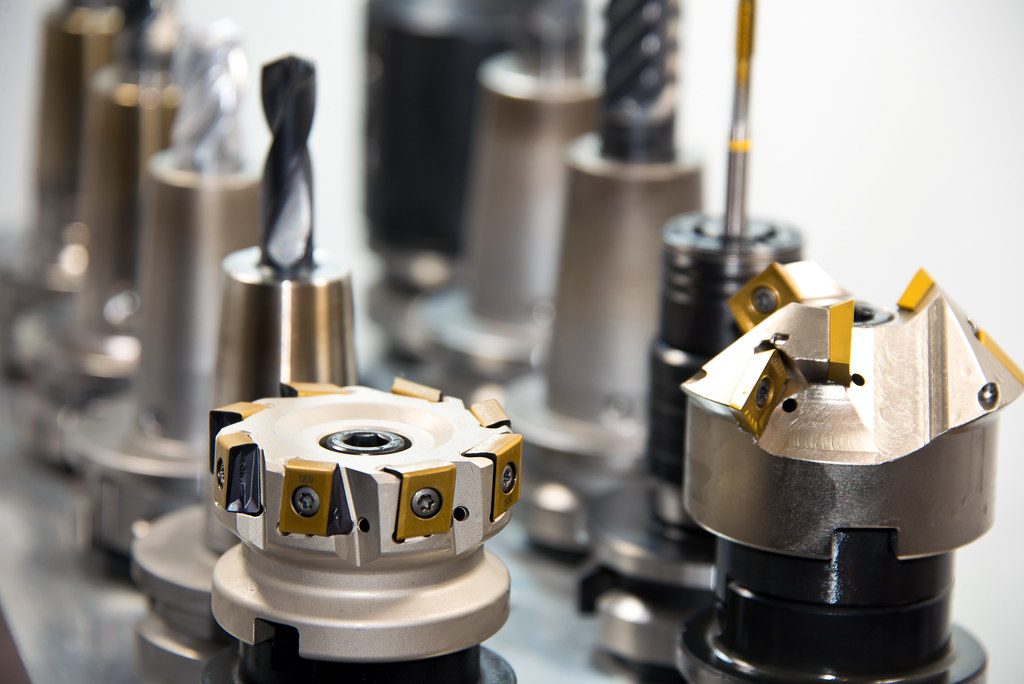
Tool holders, sized to your work, not to a wish list. For a BT40 or CAT40 machine, a practical starting set is eight to twelve holders: a mix of ER32 or ER40 collet chucks for drills and smaller end mills, a few hydraulic or shrink-fit holders for finishing where runout matters, and one or two shell mill arbors if you face large surfaces. A shell mill arbor and a face mill with inserts is often the single fastest way to turn a machine into a productive one. Budget roughly $60–$200 per holder depending on type and brand; hydraulic and shrink holders sit at the top of that band.
Collets and a tightening fixture. Collets get consumed — they wear, they get dropped, they get over-torqued. A set of ER32 collets covering 3 mm to 20 mm, plus a bench tightening fixture and torque wrench, is not optional. Collets run a few dollars each from a decent maker; the fixture is $80–$250. Buy the fixture. Tightening with a hand wrench is how you get runout and damaged nuts.
Workholding — the item most often forgotten. A machine with no vise cannot make a first article. A quality 150 mm or 200 mm precision machine vise with a swivel base runs roughly $300–$900 depending on brand and accuracy class. If your parts are plate-like, add a pair of parallels and a clamping kit. If you run repeat production, a dedicated fixture or a zero-point system pays for itself — budget several hundred to a few thousand dollars depending on the system. This is the line item where buying cheap hurts most: a vise with 0.05 mm of lift will make every part slightly different and send you chasing tenths in the wrong place.
A tool presetter, if you run more than a couple of setups a week. Off-line presetting removes tool measurement from the spindle and typically cuts setup time substantially. Entry-level optical presetters start around the low thousands of dollars; integrated laser tool setters inside the machine cost more but remove a step entirely. If your batch sizes are small and changeovers are frequent, this is the accessory that changes your throughput more than a spindle upgrade would.
Consumables and the first-cut survival kit
Cutting tools themselves are usually best bought locally or from a specialist, because geometry and coating choice depend on your material. But order the basics with the machine so you can make chips on day one: a few carbide end mills in the sizes you will actually run, a face mill with a spare set of inserts, spot drills, and a tap or two. Expect a few hundred dollars for a starter set that lets you prove the machine and qualify your first program.
Do not forget the machine-side consumables either. Coolant concentrate (typically a few dollars per litre, mixed at the maker's ratio), way lube, and a spare coolant tank filter should land with the machine, not be sourced three weeks later. A new machine running on the wrong coolant because the right one had not arrived yet is a common and avoidable way to start a long relationship with rust.
| Item | Typical budget (USD) | Buy with the machine? | Notes |
|---|---|---|---|
| Tool holders, 8–12 pcs | $500 – $2,400 | Yes | Mix of collet, hydraulic/shrink, shell mill arbor |
| Collets + tightening fixture | $300 – $900 | Yes | Wear item; buy a full range, not just the sizes you plan today |
| Precision machine vise | $300 – $900 | Yes | Accuracy class matters more than brand here |
| Clamping kit / parallels | $150 – $600 | Yes | Cheap and constantly used |
| Tool presetter | $2,000 – $12,000 | Depends on changeover frequency | Justify it against your setup hours, not against the machine price |
| Starter cutting tools | $300 – $1,200 | Partly | Source the rest locally once material mix is known |
| Coolant / way lube / filters | $150 – $500 | Yes | Wrong coolant in week one causes rust you will fight for years |
Rule of thumb from our own quotes: a complete, sane tooling and workholding package for a standard vertical machining center lands between roughly 8% and 15% of the machine price. If a supplier's tooling line is under 3%, the package is decorative. If it is over 25%, you are being sold capacity you did not ask for.
Why suppliers leave tooling off the quote
Two reasons, and both are worth understanding before you compare offers.
The first is honest but unhelpful: tooling is brand-sensitive and region-sensitive. A Hong Kong buyer and a Nairobi buyer want different holders from different makers, so the factory quotes the machine and leaves tooling to the reseller. Fine — but then somebody has to own the list, and if it is nobody, it becomes your problem after the container sails.
The second is less honest. A bare machine price looks lower than a complete one. Some quotes deliberately strip consumables, fixtures and even the coolant tank to win the comparison, then bill them later at retail. That is not necessarily fraud — it is a quoting convention — but it means comparing machine prices across suppliers without comparing tooling scope is meaningless. Ask each supplier for the same complete scope: machine, tooling package itemised, workholding, installation consumables, freight. Only then are the numbers comparable.
How to write the tooling section of your PO
A short, specific tooling annex to the purchase order prevents almost every dispute we have seen on this topic. It should list:
- Machine model, control, spindle taper and exact tooling interface — do not accept "standard BT40" without the retention knob type.
- Every holder by type and size, with quantity, and whether it includes the nut and collet.
- Workholding: vise model, jaw width, accuracy class, and whether a swivel base and stop are included.
- Consumables shipping with the machine, with quantities.
- Brand or acceptable equivalent, and what happens if the brand is unavailable.
- Packing: holders in a proper case, not loose in the crate next to the casting.
We have had buyers negotiate $4,000 off a machine and then spend $6,000 sourcing the tooling separately, in a hurry, at retail, while the machine sat idle. The discount was real. So was the loss.
The blunt version: price the machine and the tooling as one order. Get the holders, the collets and fixture, one decent vise, the coolant and the way lube on the same PO as the machine. Buy the presetter only when your changeover hours prove it. And when you compare suppliers, compare the complete scope — a cheap machine with a missing tooling package is not a cheap machine.
If you are ordering a machining center and want a second pair of eyes on whether a tooling package is complete, send us the quote and the parts you intend to run. We will tell you what is missing, what is padded, and what you can safely buy locally instead of shipping across an ocean.