
We sell both formats. That matters because a supplier who only makes one will always tell you it is the one you need. Our shipping records tell a different story: roughly half our mid-size venue orders are point source, half are compact line array, and the split tracks closely with room geometry rather than buyer prestige. A narrow balcony-heavy theater wants a line array. A wide low-ceiling banquet hall usually wants point source. The buyer who ignores the room to chase a format ends up spending twice to fix what physics broke.
What each format actually does in a room
A point source loudspeaker radiates sound spherically. Level drops 6 dB every time you double the distance. In a shallow, wide room that is exactly what you want — even coverage front to back without needing complex prediction software. Modern high-output coaxial and two-way cabinets can cover 30–40 meters comfortably, and a pair flown left-right handles most rooms under 1,000 seats with headroom to spare.
A true line array behaves as a cylindrical wavefront over its effective length. Level drops only 3 dB per doubling of distance within the near field, which means the back row hears much closer to what the front row hears. That advantage only materializes when the array is tall enough relative to wavelength and the room is deep enough to need it. Hang four boxes in a 12-meter-deep club and you are paying for line-array behavior you cannot use. Hang twelve in a 50-meter arena and the math works.
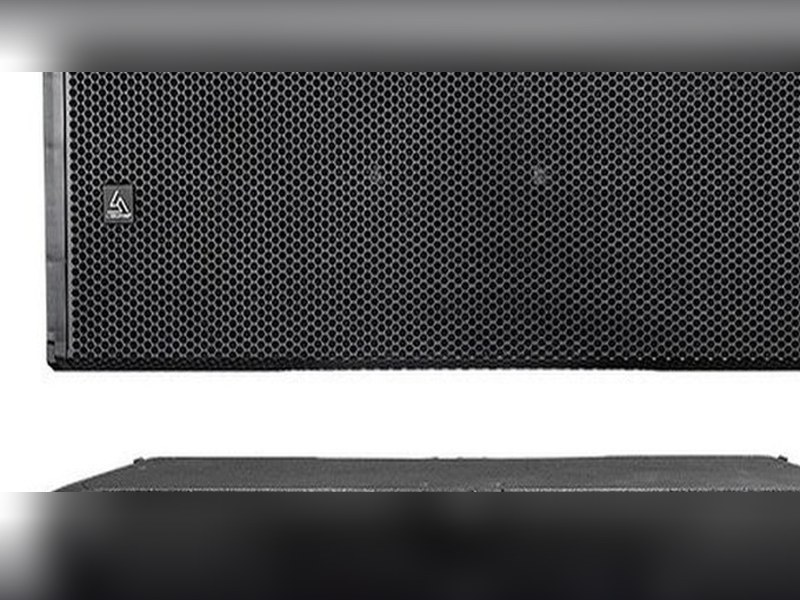
This is where honest suppliers lose deals to glossy ones. The catalogue shows twenty-four boxes hanging in an arena. Your venue holds six hundred people. We will quote you the smaller array or the point source option and explain why — and some buyers go elsewhere because they think we do not understand their project. Three months later they come back after the first installer's system leaves the balcony silent and the stage wall shaking. Room geometry wins every argument eventually.
The costs nobody puts in the tender
Sticker price per box is misleading. A single line array cabinet often costs less than a comparable point source box, which makes the format look cheaper until you add the rest of the bill:
- Rigging hardware. Line arrays need frames, fly bars, motorized hoists and safety bonds rated for the full hang weight. For a 12-box hang, rigging alone can run USD 3,000–8,000 depending on venue anchor points and local safety codes. Point source systems often mount on simple brackets or ground-stacked poles.
- Prediction and tuning time. Every line array deployment needs modeling software (EASE Focus, Soundvision, or proprietary tools) and an experienced system engineer on-site to verify coverage. Budget USD 1,500–4,000 for a mid-size install if you do not have this skill in-house. A good point source system can be aimed by ear and verified with a measurement mic in an afternoon.
- Crew skill. Rental companies switching from point source to line array routinely underestimate training time. Rigging mistakes are not cosmetic — they kill people. If your crew has never hung arrays, factor certified training into year-one cost.
- Spares strategy. A failed point source cabinet degrades coverage locally. A failed line array element breaks the wavefront and creates audible lobing across the entire venue. Spares buffer should be larger for arrays.
| Cost line | Point source (typical) | Compact line array (typical) |
|---|---|---|
| Loudspeakers (system) | USD 8,000–25,000 | USD 15,000–60,000 |
| Rigging & hardware | USD 500–2,000 | USD 3,000–8,000 |
| Prediction & commissioning | USD 500–1,500 | USD 1,500–4,000 |
| Crew training (first year) | Often included | USD 2,000–5,000 |
| Spare parts buffer | 5% of system | 8–10% of system |
The ranges overlap deliberately. A premium point source install can out-cost a budget line array, and vice versa. What matters is that the buyer builds the full model before comparing quotes. We have lost tenders where our point source bid was genuinely better for the room, but the competitor's line array unit price looked lower and the evaluation committee did not add the rigging line. Six months later the venue called us to fix coverage problems the cheaper system created.
A blunt take: If your venue is wider than it is deep, has a ceiling under 8 meters, or seats fewer than 400, start with point source. You may still end up with a compact array after proper modeling — but starting from the assumption that "line array is professional" is how budgets break. We have talked buyers out of arrays more often than into them, and those buyers reorder.
When line array genuinely wins
We do not want to oversell the contrarian case. Line arrays earn their keep in specific conditions, and when those conditions exist, no amount of point source stacking substitutes:
- Deep rooms with balconies. The cylindrical wavefront delivers consistent SPL to multiple tiers without blasting the front rows. This is the textbook use case and it is real.
- Outdoor festivals with throw requirements over 40 meters. Spherical decay kills point source at distance outdoors. Arrays maintain intelligibility where point sources turn to mush.
- Rental inventory flexibility. A scalable line array system lets a rental company deploy 4, 8, 12 or 16 boxes from the same SKU pool. Point source inventory fragments into multiple models for different jobs.
- Venues with strict noise ordinances. Properly tuned arrays concentrate energy on the audience area and reject ceilings/walls more effectively than point source, helping meet leakage limits without sacrificing in-room level.
Notice what is not on that list: "prestige," "looks impressive," or "what the touring acts use." Those are real motivations — humans buy things for emotional reasons all the time — but they belong in the marketing conversation, not the engineering one. When a buyer tells us they want a line array because their competitor has one, we ask for the room drawings first. Sometimes the competitor made the right call. Sometimes they didn't, and our buyer has a chance to do better.
How we help buyers decide
Our process is unglamorous and repeatable. We ask for floor plans, section drawings, seating count, intended program mix (speech, music, mixed), noise limits and crew experience level. We model both options when the room is borderline. We show predicted SPL maps, not just spec sheets. We include rigging, cabling, processing and commissioning in the quote so the comparison is apples-to-apples. And we tell buyers when neither of our options is right and they should look elsewhere — because a forced sale becomes a support ticket that costs more than the margin.
The mid-size venue market is where most buyers live and where most bad decisions happen, because the stakes are high enough to justify serious gear but not high enough to hire a dedicated acoustician. That gap is where honest suppliers earn their keep. Whether you end up with a line array or point source, make sure someone did the math before the money moved. The room will test the decision whether or not you tested it first.