
We have shipped white-label PA speakers, portable line arrays and studio monitors to brand owners across Europe, the Middle East, Africa and Southeast Asia for years. The pattern is always the same. A retailer or AV installer has a customer base, a logo and a distribution channel, but no production line — and they rightly realize they do not need one. Plenty of the biggest audio names on any trade show floor are white-label combinations of an OEM chassis, a chosen driver, a tuned DSP preset and a sticker. The difference between a brand that survives and one that quietly disappears is not factory ownership. It is whether someone did the boring homework on the supply side.
Pick the OEM, not the prettiest catalogue
The biggest mistake we see is a distributor falling in love with one factory's glossy brochure and locking in on a single model before understanding how the factory actually behaves as a long-term partner. A product photo tells you nothing about MOQ flexibility, driver sourcing, QC consistency or whether the acoustics engineers will talk to you honestly. Before committing to a white-label partner, we run through a short checklist with the buyer:
- Does the factory own its tooling for the cabinet? Plastic injection or sheet-metal bending in-house means faster revisions and cheaper per-unit cost. Resellers of another brand's OEM line add cost and thin your margin before a single box ships.
- Will they put your brand on the product, packaging and manual? Genuine white-label means your logo on the grille badge and the box. Some "OEM" factories only offer a shared catalogue with a rebranded carton — check what actually gets printed on the hardware.
- Can they do custom cabinet color and grille? That is the cheapest way to make a generic speaker look like your brand rather than like ten other distributors' products.
- What is the real MOQ and lead time? A factory quoting 50 units might mean 150 once you count minimum order per color and per SKU. Ask for the MOQ table, not a single round number.
We have both supplied from in-house lines and brokered between buyers and factories, and we will say it plainly: a supplier who lets you visit, meet the engineers and audit the QC process is worth more than one who only promises "high quality" in a chat message. If you cannot visit, ask for live video walk-throughs of the assembly line and the anechoic test station before you commit volume.
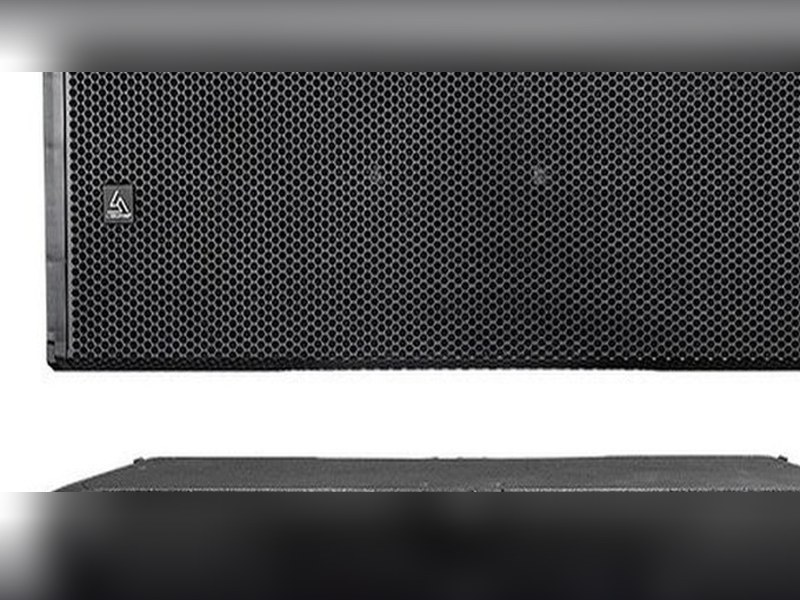
Read the spec sheet like a buyer, not a fan
Audio spec sheets are where marketing does the most damage. Peak power is quoted because everyone quotes it; nobody displays sustained RMS power as prominently because it is a smaller, more honest number. When we review a quote with a distributor, we cross-check three numbers in particular:
- RMS vs peak power. Ask explicitly for continuous (RMS) power at 8 ohms, not the momentary burst figure. A "5,000W" PA system is often 1,200W RMS continuous. Both numbers can be true — just make sure you know which one your customer is hearing when you sell it.
- Frequency response at what tolerance? "-3dB" and "-10dB" look identical on a printed page but describe very different real performance. A speaker quoted as 50Hz–20kHz at -10dB rolls off hard below 100Hz at -3dB. Know which one your installer customer actually needs for the room.
- Sensitivity and SPL. Sensitivity in dB/W/m directly determines how loud the system gets for a given amplifier power. Two "500W" speakers can differ by 6dB in maximum output because one has higher sensitivity. That difference is more valuable than an extra 100W on the amp.
Any serious white-label factory can hand you the actual measurement curves and driver datasheets for the units they propose. If the supplier dodges the question or sends a marketing one-pager, treat it as a warning. We keep driver spec sheets and DSP tuning files on file for every white-label line we quote — because one day your customer's system engineer is going to ask, and you do not want to forward a brochure as the answer.
| Spec line | What it really tells you | What to ask for |
|---|---|---|
| Power output | Peak numbers flatter; RMS tells the sustained truth | Continuous (RMS) at 8 ohm, plus amp headroom |
| Frequency response | Tolerance changes the real range dramatically | Response at -3dB, not only the -10dB figure |
| Sensitivity | dB/W/m predicts loudness more than watts do | Measured sensitivity and max SPL |
| Impedance | Defines amp matching and how many per channel | Nominal and minimum impedance |
| Driver brand | Identifies a real design vs a generic build | Driver make/model and datasheet |
Price the line so it survives the first year
White-label audio margins look generous on paper and evaporate fast in practice. A distributor who prices purely off the FOB cost of one product forgets the box. We encourage buyers to build a full landed-cost model before setting a retail price — product cost, freight, import duty, certification, packaging design, warehousing, warranty reserves and marketing. The warranty reserve is the line most distributors skip, and it is the one that decides whether the brand lasts.
On pricing ranges: a small portable powered PA speaker with a decent driver and DSP will typically land at USD 120–250 FOB for reasonable volumes, while a mid-size line array cabinet with a subwoofer and amplifier rack runs USD 300–800 per box depending on driver grade, power and finish. Certification is a real line item too — CE for the EU, FCC for North America, and sometimes a regional safety mark for the Middle East. Work that cost into the model rather than treating it as an afterthought that quietly eats the margin.
A blunt take: Do not quote a 2,000W PA system to a club owner if the RMS figure is 800W. The customer will buy once, run it hard, and the burnt amp or blown driver becomes your warranty claim — not the factory's. Honest specs make for repeat orders; inflated ones end the relationship. We would rather lose a deal on honesty than win one we cannot stand behind.
The part that keeps brands alive
Plenty of distributors can get a container of white-label speakers onto a dock. The ones who stay in the game treat it like a product line, not a one-off purchase. They keep consistent driver choices across models so a system engineer can match cabinets and subs from the same sound signature. They hold back a small spares buffer of amps and drivers so a field failure becomes a same-week replacement instead of a month of downtime. And they build a relationship with the OEM that lets them revise a cabinet, change a grille color or add a model without renegotiating from zero.
That is the whole trick of white-label audio. The factory gives you the DNA; your brand gives it a voice. Get the OEM selection, the honest spec reading and the pricing model right, and the product sells itself to your existing customers. Get them wrong, and the logo on the badge will not save you. We have seen both outcomes on our own shipping records — happy to help the first kind of buyer build their line.