
Every few weeks a buyer sends us a video of an automated guided vehicle or an autonomous mobile robot and asks for a quote. Nine times out of ten, they cannot yet tell us which one they watched, or why. That is not their fault — the marketing has blurred the two categories on purpose, because "AMR" sells better than "AGV" and the price gap between them is real.
So let us draw the line clearly, because it decides everything downstream: how the plant gets prepared, how much integration costs, and whether the fleet survives contact with a busy aisle.
The one difference that matters
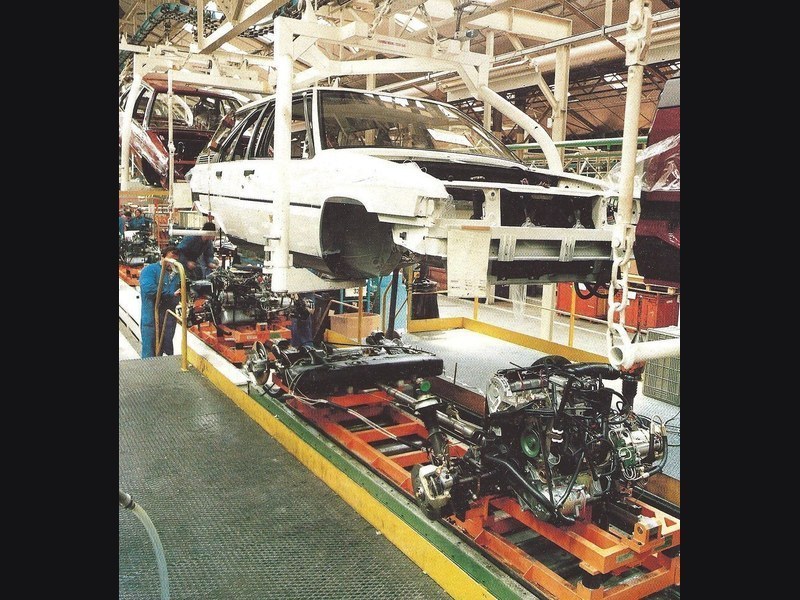
An AGV — automated guided vehicle — follows a fixed path. That path might be a magnetic tape strip on the floor, a painted line read by a camera, a wire buried in the concrete, or a reflector grid. The vehicle knows where it is because it senses the path. Take the path away and it stops. Move a pallet into the corridor and it stops or waits. The route is engineered, installed and maintained.
An AMR — autonomous mobile robot — builds a map of the space with lidar and cameras, localises itself against that map, and plans its own route to a destination. Nobody lays tape. If a pallet blocks the aisle, it recalculates and goes around. If you add a new workstation, you redraw the map and the fleet adapts. The route is software.
That single difference drives everything: cost, lead time, flexibility, and how much of the project lands on your facilities team versus the robot's software team.
| Factor | AGV (fixed path) | AMR (free navigation) |
|---|---|---|
| Guidance | Tape, wire, reflector, painted line | SLAM map, lidar, cameras |
| Plant preparation | Floor marking/wiring, downtime, works order | Mostly a mapping run and charger drops |
| Route change | Physical rework, days | Redraw in software, hours |
| Handles congestion | Poorly | Recalculates and reroutes |
| Throughput per robot | High, very repeatable | Good, slightly variable |
| Typical unit cost | Lower | Higher |
| Best environment | Stable, single-purpose, high-volume lanes | Mixed traffic, changing layout, many stops |
When an AGV is genuinely the better buy
The industry has spent five years telling buyers that AMRs make AGVs obsolete. That is not true, and buyers should push back on it.
Fixed, high-volume lanes. If a machine feeds the same conveyor in the same place for three shifts a day, forever, there is no route to optimise. A tape-guided tugger with a well-built train will move more tonnage per dollar and per hour than an equivalent AMR fleet, and it is simpler for maintenance to keep running.
Clean, controlled, repetitive environments. A warehouse back-of-house corridor, a cleanroom, a beverage plant with predictable traffic — no forklifts cutting across, no pallets parked in random places. AGVs were designed for exactly this and they do it reliably.
Very heavy payloads. When you are moving 2–10 tonne coil or stamping dies on a fixed loop, the guidance technology is a rounding error in the project, and the mechanically simple AGV is easier to certify and to keep safe around people.
Budget-constrained single lane. If your entire case is "get parts from the saw to the mill, 200 times a day, along one 40-metre lane", a tape AGV does it for a fraction of an AMR fleet's cost. Do not buy a self-driving philosophy to solve a conveyor problem.
When you actually need an AMR
The layout changes. If your plant rearranges every time you win a new contract, tape is a liability. You will end up refusing changes because rerouting the AGV costs a weekend, and that is a bad way to run a factory.
Traffic is mixed and messy. People, forklifts, carts, and pedestrians sharing space. AMRs handle dynamically appearing obstacles with their own sensors; a tape AGV driving into a parked pallet is a daily event.
Many pickup/drop points. The more stops your process has, the more a fixed path network resembles a spiderweb of tape, and the more it fails. AMRs scale linearly with stops; AGV infrastructure scales with the complexity of the network, badly.
Fast deployment matters. An AMR pilot can be mapped and running in a week in a quiet shift. Installing and commissioning a reflector or tape network across a live plant usually means production interference and a longer schedule.
The question that cuts through the sales deck: "In three years, will this route and these stops be exactly where they are today?" If the answer is a confident yes, price an AGV. If there is any chance the answer is no, an AMR is usually cheaper over the life of the project, even at a higher unit price.
Sizing the fleet — the math people skip
Buyers almost always under-buy, then discover the fleet can't keep up, then blame the vendor. The real number is not how many robots you need — it is how many you need at peak, and how many are charging at any moment.
Work it through like this:
Count the deliveries per hour at your busiest shift. Say 60 pallet moves per hour. Measure the round-trip time for one trip, including loading and unloading: travel plus dwell. If a round trip is 4 minutes, one robot delivers 15 loads per hour. So you need 4 robots running flat out — which is already wrong, because robots need to charge, and 100% utilisation is a fantasy. Add charge time and realistic availability, and 4 becomes 6.
Now the chargers. Most AMRs run 2–6 hours on a charge depending on payload and duty, and charge in 1–2 hours. If a robot spends a fifth of its life on a charger, your effective fleet is 80% of what you paid for. Plan charger positions so a robot can top up opportunistically between jobs rather than hauling back to a corner, and never size the fleet assuming opportunity charging you have not actually bought.
| Payload class | Typical duty | Indicative unit price (China, 2026) |
|---|---|---|
| 100–300 kg | Small parts, bins, carts | USD 8,000–18,000 |
| 300–500 kg | Small totes and shelves on castors | USD 6,000–14,000 (AMR) |
| 500–1,000 kg | Pallets and heavy totes | USD 15,000–35,000 |
| 1,000–1,500 kg | Heavy pallet handling | USD 30,000–60,000 |
| Tugger / train | Multi-cart trains, 1–5 t pull | USD 20,000–55,000 |
Treat those as starting points only. Payload rating, lift type (roller top, lift pin, hook, fork), navigation quality, and battery chemistry move the number a lot. A tape AGV of the same payload usually costs 30–50% less than the AMR figure — which is exactly why the layout question decides the project.
The costs that live outside the robot
The robot is maybe half of the delivered, working project. The rest is where first-time buyers get surprised:
Integration. Call buttons, conveyor interfaces, automatic doors, traffic-light or zone control at intersections, and the WMS/MES link that decides what moves where. If the robot cannot talk to your warehouse system, a human still has to dispatch every job, and you have bought a very expensive cart.
Floor and facility work. AMRs need reasonable floor flatness and clean reflective surfaces — wall-to-wall glazing and mirror-polished floors confuse lidar. AGVs need the guidance installed and protected. Both need charger power drops run in the right places.
People and process. Somebody has to own the fleet, the maps and the exceptions. Fleets fail quietly in month four, when the champion who deployed them moves on, and nobody updates the map after the layout changed. Budget for training and for one named owner.
Safety guarding. Mobile robots share space with humans, so you need the safety-rated sensors, speed zones and emergency stops configured for your actual traffic, not the demo lane. This is not optional and it is not cheap to retrofit.
How to de-risk a first deployment
Do not buy a plant-wide fleet first. Run one lane. Take your worst physical job — the one people hate, the one with the most walking and the emptiest hours — automate that single loop, and prove it against a fixed KPI: moves per shift, uptime, exception rate. One lane tells you more about whether the technology fits than any demo.
Insist on a site visit, or at minimum a video call where the supplier maps your actual aisles, not a stock photo. Ask what happens when a person stands in front of the robot, when a pallet is slightly out of position, when the wifi drops, and when the floor is wet. Ask who carries spare parts in your region and how fast a wheel motor or a battery can be replaced. A fleet down for three weeks waiting on a part from overseas costs more than the price difference between two vendors.
Finally, get the throughput commitment in writing — moves per hour at your duty cycle, with your load weights, not a lab figure. The vendors who will put that in a contract are the ones worth talking to. The ones who say "it depends" and won't commit are telling you something too.
If you are weighing a first mobile robot project and want a second opinion on whether the layout wants fixed-path or free-navigation, send us your plant layout and the moves you do per shift. We will tell you which technology the numbers point to — and if the honest answer is that a conveyor or a better route would beat both, we will say so.